
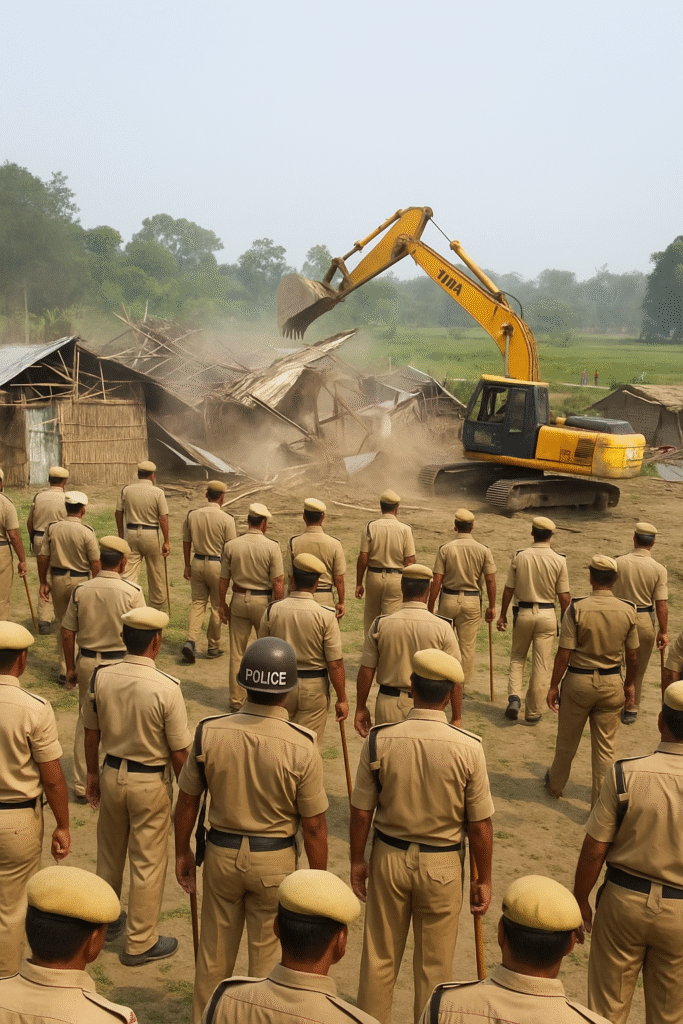
🔹 Introduction: A State on the Edge
Assam is once again making headlines. In 2025, multiple eviction drives have sparked a renewed Hindu-Muslim conflict and exposed deep-rooted fractures within Assamese society. At the center of it all is the Assam eviction Bangladeshi conflict — a highly political and emotionally charged debate that refuses to go away.
While the government claims the evictions target “illegal Bangladeshi settlers,” a growing number of people question whether this is merely a political strategy wrapped in a nationalist package.
The ongoing Assam eviction drive is not just a government operation—it’s becoming a defining moment in the state’s socio-political fabric.
Adventure tourism Assam 2025 Assam travel destinations
🔹 Who Are These So-Called ‘Bangladeshis’?
For years, the term Bangladeshi migrant has been loosely used in Assam’s political and social discourse. But when the government begins bulldozing entire settlements, people start asking:
- If the government knows they are Bangladeshi, why aren’t they being deported to Bangladesh?
- If they are illegal migrants, how did they get Aadhaar cards, ration cards, and PMAY houses?
- If they’re not Bangladeshi, why is their identity being weaponized to snatch their land?
👉 These are no longer questions for fringe voices. They are being echoed by civil rights groups, opposition parties, and even some bureaucrats behind closed doors.
🔹 Government Narrative: “Evicting Illegal Encroachers”
The BJP-led Assam government has repeatedly stated that its eviction drive is part of its “zero tolerance policy” against illegal encroachment of government land. But here’s where the conflict begins:
- Most eviction zones are dominated by Bengali-speaking Muslims.
- No transparent mechanism exists to verify their citizenship.
- Some evictees have land records, voter IDs, and Aadhaar.
So, who are we evicting?
If they’re Indian citizens, then this is a human rights crisis.
If they’re foreign nationals, why is there no repatriation agreement with Bangladesh?
Visit Kaziranga National Park – The Kingdom of the One-Horned Rhino
🔹 Where Are the Evicted People Going?
Another crucial part of the Assam eviction Bangladeshi conflict is the lack of rehabilitation.
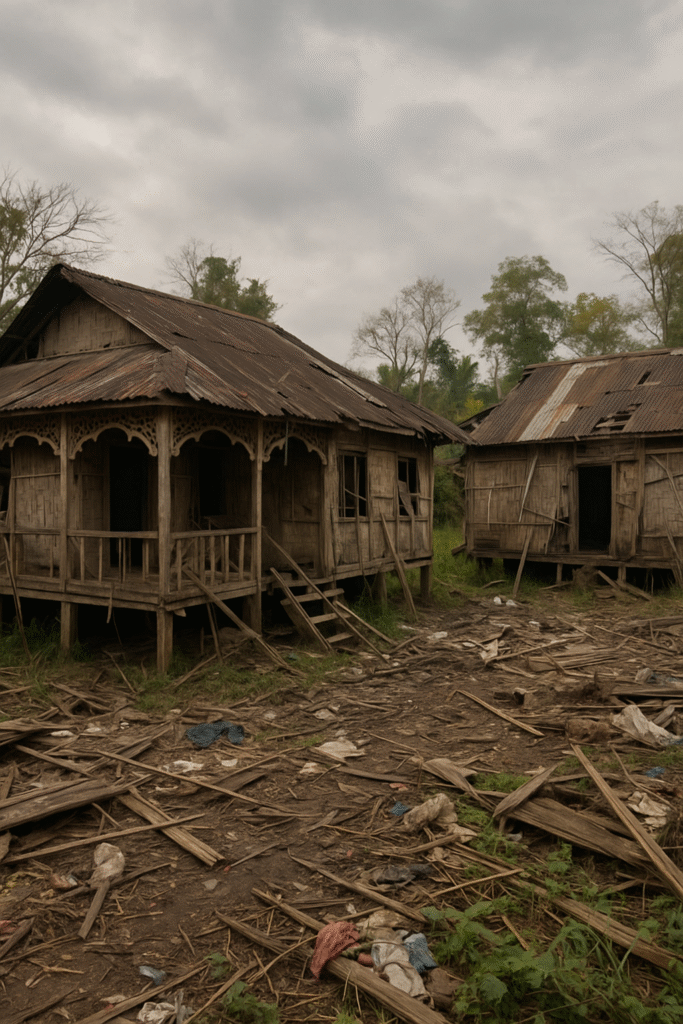
When bulldozers demolish homes, no alternate housing is provided.
➡️ Many displaced families now live in makeshift huts by highways, abandoned schools, or crowded with relatives.
➡️ Children drop out of school, people lose livelihoods, and women face insecurity in open shelters.
This begs a larger question:
If the government knew they were “Bangladeshi migrants”, then where are they supposed to go? Surely not to another illegal settlement?
🔹 The Land Angle: Corporate Takeover or National Security?
Critics argue that the evictions are part of a larger land grab policy. The government’s silence on what will happen to the vacated land fuels this suspicion.
Some questions worth asking:
- Are these eviction zones part of a future land bank?
- Will this land be leased or sold to corporations like Adani for industrial corridors or agricultural contracts?
- Is this just ethnic cleansing under the guise of legality?
Whether true or not, these questions dominate the public sphere and form a core part of the Assam eviction Bangladeshi conflict.
🔹 Eleven Years of BJP Rule: Who’s Responsible?
The BJP has ruled Assam since 2014 and at the center since 2014. During this time:
- Lakhs of alleged illegal migrants continued to access welfare schemes.
- Many received Aadhaar, PM-KISAN, Ujjwala gas, ration cards, and more.
- Local leaders quietly gained vote banks by allowing settlements to grow.
Now suddenly, just before the 2026 elections, the government claims these people are foreigners?
Why didn’t they act earlier? Why now?
🔹 Is This a 2026 Pre-Election Strategy?
There is rising concern that the eviction drive and communal tension are not policy tools but political tools.
▶️ Goal 1: Polarize voters on Hindu vs Muslim lines.
▶️ Goal 2: Gain sympathy from “indigenous Assamese” by portraying eviction as protecting Assam.
▶️ Goal 3: Divert public attention from major corruption scandals involving ministers.
Political observers believe this is not new — the same tactic was used before the 2021 elections.
Communal fear + law & order = controlled outrage + votes.
Inside Assam’s Coal & Supari Syndicate – Full Crime Report
🔹 Social Media: New Battlefield of Hate
Facebook, Instagram, and X (Twitter) are flooded with communal propaganda. Some “influencers” from both Hindu and Muslim communities:
- Post inflammatory content for likes and followers.
- Claim to be “protectors” of their religion.
- Promote fake news, hate videos, and call for violent responses.
These individuals are not helping the debate. They are weaponizing emotions for clout, making the Assam eviction Bangladeshi conflict worse.
🔹 Most Media Are Government Mouthpieces
In the midst of this chaos, the role of mainstream media has been disappointing.
- National TV channels give biased coverage.
- Regional outlets often fear backlash or lose ad revenue.
- TRP wins over truth.
As a result, the real questions are never asked.
Instead, we see loud headlines, dramatic visuals, and selective outrage. There is no space for ground reports, documentation, or policy critique.
🔹 What Do the People of Assam Really Want?
Most common Assamese — Hindu, Muslim, Tribal, Bengali — just want peace.
They want:
- Transparency on citizenship claims.
- Human dignity in eviction processes.
- Equal treatment under the law.
- Accountability from elected leaders.
They are tired of being used as pawns in a political chessboard that plays every five years.
For the Assam eviction to gain public trust, transparency is non-negotiable. People want evidence, not just bulldozers.
NRC, Citizenship, and The Hidden Politics Behind Assam’s Eviction Drive
🔹 NRC, CAA & The Citizenship Conundrum
Assam is the only state in India that completed a full National Register of Citizens (NRC). Its goal was to identify genuine Indian citizens and detect illegal Bangladeshi migrants.
But here’s what happened:
- NRC listed 1.9 million people as “excluded”, many of them Hindus.
- The BJP, which initially supported NRC, rejected the final list, citing errors.
- Then came the Citizenship Amendment Act (CAA), offering citizenship to non-Muslim immigrants — but CAA rules have not been notified till now.
So now, no one knows who is Indian and who is not.
👉 The result? More confusion. More evictions. More communal tension.
🔹 Assam Police: Peacekeepers or Political Tool?
The Assam Police have been leading the eviction drives, often without warning or proper legal notice.
Eyewitnesses from Barpeta, Darrang, and Nagaon districts reported:
- Night-time raids on homes.
- Lathi charges on protesting women and children.
- No time to pack belongings, let alone challenge orders.
A few local officers have even spoken off the record, saying they’re uncomfortable with orders that target one community more than others.
This creates distrust — not just between citizens and the police, but within the police ranks too.
🔹 Eyewitness Accounts: Life After Eviction
Let’s look at some human stories that never make it to national headlines:
1. Sakina Begum, 48, Morigaon:
“We lived here for 20 years. I voted in every election. Now they call me Bangladeshi and bulldozed my home. My youngest child is mentally ill and has no place to sleep.”
2. Nurul Haque, 36, Barpeta:
“We had land documents from 1994. But we were told our village was ‘government forest land.’ They didn’t even allow us to show our papers.”
3. Rafiq Ali, 17, Nagaon:
“We were preparing for Class 12 board exams. Now I study under a tarpaulin tent beside a road. What future will I have?”
These are not isolated incidents. They are part of the Assam eviction Bangladeshi conflict that questions the very essence of identity and justice.
🔹 Corruption and Scapegoating: Who Benefits?
In 2025, multiple corruption allegations rocked the Assam government:
- The Education Minister was accused of embezzling funds from digital education programs.
- A top Irrigation Department officer was caught with crores in undeclared property.
- Allegations of land deals involving ministers’ relatives surfaced — especially in areas recently vacated by eviction.
Coincidentally, the eviction drives intensified just after these scandals broke.
Is this just a distraction tactic?
Instead of addressing corruption, the focus was shifted to a communal issue that divides, not unites.
Assam Beef Ban: Business Game in the Name of Religion?
🔹 Business Behind the Bulldozers?
Several sources claim that large plots of land cleared during eviction are being considered for:
- Industrial corridors
- Solar farms under Adani Green
- Special economic zones (SEZs)
While the government has not confirmed this officially, RTI activists allege land transfer proposals exist on file.
This raises a haunting question:
👉 Is the Assam eviction drive really about illegal Bangladeshi settlers, or is it about creating land banks for the elite?
https://www.business-standard.com
🔹 Role of Influencers & Social Media Propaganda
Many self-proclaimed leaders have emerged on Instagram and Facebook, often with inflammatory content.
Some examples:
- Hindu hardliners calling for more aggressive eviction of “land grabbers.”
- Muslim influencers using victim narratives for political gain.
- Fake news accounts spreading edited videos, doctored land documents, or photoshopped violence.
These viral posts are often monetized for views or used to build political careers.
Social media is no longer a mirror. It’s a weapon.
🔹 What Is the Truth?
At this stage, the truth is layered:
- Yes, some illegal immigration from Bangladesh exists — that is undeniable.
- Yes, land encroachment is a problem in Assam — by all communities.
- Yes, some evictions were necessary.
But equally true:
- Many genuine Indian citizens have lost homes.
- The eviction drive lacks transparency, consistency, and humanity.
- Political motives are impossible to ignore.
This is not just a law enforcement issue — it’s a social, political, and humanitarian crisis.
🔹 Assamese Support for Government — But Only If It’s Genuine
It’s important to acknowledge a crucial truth in the entire debate:
▶️ Many Assamese people support the government’s eviction drive, provided the real aim is to remove illegal Bangladeshi migrants from Assam.
Their support comes not from hatred, but from a deep-rooted fear — the fear of losing their land, culture, and identity.
No one wants an outsider to control their home. Every family, regardless of religion, wants safety, jobs, and land for their children.
But the Assam eviction Bangladeshi conflict becomes questionable when no one knows where these “Bangladeshis” are going after eviction.
👉 If they’re truly foreign nationals, why is there no repatriation data, no deportation strategy, and no cross-border coordination?
🐮 Gorukhuti Gir‑Cow Scandal 2025: Allegations Against BJP Minister Jayanta Malla Baruah
🔹 Where Are These People Going?
As per local sources and independent ground reports, most evicted families are not deported, but are instead relocating to nearby cities and towns, such as:
- Guwahati
- Nagaon
- Bongaigaon
- Silchar
- Dhubri
- Major parts of Lower Assam
➡️ This raises a troubling concern: Are we merely shifting the problem, not solving it?
If no official rehabilitation or deportation is done, and if the same families resettle elsewhere in Assam, what’s the long-term solution?
👉 Will this cycle continue until every city faces the same eviction drama?
👉 Are we truly addressing the Assam eviction Bangladeshi conflict, or just repainting the map?
🔹 A Demand From the Common People
We, the people of Assam — across religious and ethnic lines — have a simple, united demand:
“If the government truly evicts Bangladeshis for the benefit of local Assamese people, then show us the facts.”
We ask:
- How many people have been deported to Bangladesh?
- What agreements exist with Bangladesh to accept them?
- What legal documents prove that these evictees are not Indians?
- What is the post-eviction plan to ensure they don’t resettle elsewhere in Assam?
Only data-backed transparency can convince people that this isn’t just political theatre before the 2026 elections.
If this is truly for the protection of Assam’s land and identity, then the government should come forward with clear proof and policy documents.
Otherwise, people will keep believing that once the political goals are fulfilled, these same groups will return to other towns and repeat the cycle.
🧠 Final Word
Assam stands at a crossroads.
The Assam eviction Bangladeshi conflict is not just about land or religion. It’s about truth vs. perception, power vs. people, and transparency vs. propaganda.
We urge every policymaker, journalist, and citizen:
If the Assam eviction is genuinely for protecting the rights of local Assamese people, then data, plans, and accountability must be presented clearly.