
HDFC Bank Minimum Balance Hike 2025 — What Has Changed?
After ICICI Bank’s shocker, the HDFC Bank minimum balance hike 2025 has become the next big jolt for Indian customers. Starting 1 August 2025, HDFC Bank has raised the average monthly balance (AMB) for new savings accounts in metro and semi-urban branches to ₹25,000, while rural branches now require ₹10,000.
This steep increase from earlier limits has left many wondering how to manage their money without losing out to penalty charges. In this guide, we’ll break down exactly what the HDFC Bank minimum balance hike 2025 means, who it affects, what penalties apply, and the best ways to avoid extra costs while keeping your account active.
Starlink to Launch Soon in India – What You Need to Know
Why This Matters to Everyday Customers
For many Indians, a savings account is the first step into formal banking. But with a higher minimum balance comes a heavier financial burden.
- Higher Cost of Banking – If your account balance dips below the required level, you’ll be charged penalties that can eat into your savings.
- Reduced Accessibility – Students, freelancers, and small-income earners may struggle to keep such a high balance, pushing them toward public sector banks or digital-only options.
- Changing Banking Culture – Private banks appear to be moving toward high-value clients, while low-income customers risk being sidelined.
Who Will Be Affected by the HDFC Bank Minimum Balance Hike 2025
- New Customers – If you open an HDFC Bank savings account after 1 August 2025, you’ll need to keep ₹25,000 (metro/semi-urban) or ₹10,000 (rural) at all times to avoid fees.
- Existing Customers – No change for you; your old balance rules still apply.
- Salary and Zero-Balance Accounts – These accounts remain unaffected; you can still have zero balance without penalty.
The Bigger Picture — Following ICICI Bank’s Lead
Just weeks ago, ICICI Bank increased its metro and urban branch AMB to a massive ₹50,000 for certain accounts. Now HDFC’s ₹25,000 limit seems modest in comparison — but it’s still a significant leap.
If two of India’s largest private banks have done this in quick succession, others like Axis and Kotak Mahindra may not be far behind.
This is no longer an isolated policy — it’s a banking trend that could change how millions of Indians manage their money.
Elon Musk Biography 2025: From Childhood Genius to Tech Billionaire & Space Visionary
Why Banks Might Be Doing This
While HDFC hasn’t offered a detailed explanation, industry experts point to a few possible reasons:
- Rising Operational Costs – Managing accounts with low balances may not be profitable for banks.
- Push Toward Premium Services – Higher balance rules encourage customers to upgrade to premium or value-added accounts.
- Encouraging Digital Banking – With UPI and mobile payments booming, banks might want fewer low-balance accounts clogging their systems.
Real People, Real Problems — A Short Story
Ramesh, a 26-year-old IT support worker, recently moved to a metro city for his job. He planned to open an HDFC account near his new office, but the banker informed him of the new ₹25,000 rule.
“For me, ₹25,000 is more than my monthly rent,” he says. “If I lock that in a savings account, I’ll have very little left for daily expenses. I’m now looking at public banks instead.”
Ramesh’s situation is becoming more common. For those without a steady surplus of funds, this policy can be a deal-breaker.
🇮🇳 “Indian Billionaires 2025: Top 10 Richest People & Business Empires in India”
Your Options If This Rule Hits You
If you were planning to open a new HDFC Bank account and now feel discouraged, here’s what you can do:
- Opt for a Zero-Balance Account – Choose a salary account or a Basic Savings Bank Deposit Account (BSBDA).
- Switch to a Public Sector Bank – Many PSU banks have much lower or zero AMB requirements.
- Explore Digital-First Banks – Some fintech banks offer free accounts with no minimum balance.
- Negotiate With Your Employer – If your salary is credited to HDFC, ask for it to be linked to a zero-balance salary account.
The Silent Shift in Indian Banking
This isn’t just about one rule change. It’s about the direction private banking is heading — fewer services for low-balance customers, more focus on those who can maintain large deposits.
While this may improve efficiency and profitability for banks, it risks leaving behind millions of everyday Indians who rely on affordable banking services.
Antilia House: India’s Billionaire Skyscraper and the Stories Behind It
Penalty Charges Under the New HDFC Bank Minimum Balance Hike 2025
Failing to maintain the average monthly balance (AMB) in your HDFC Bank savings account could result in steep penalty charges.
For new accounts opened after 1 August 2025:
- Metro & Semi-Urban Branches (AMB ₹25,000)
- Shortfall up to 50%: ₹600 + GST per month
- Shortfall above 50%: ₹1,000 + GST per month
- Rural Branches (AMB ₹10,000)
- Shortfall up to 50%: ₹300 + GST per month
- Shortfall above 50%: ₹600 + GST per month
These charges are deducted automatically from your account, which can trigger a chain reaction — lower balance → more charges → even lower balance.
AMB Rules Across Major Banks — 2025 Comparison
| Bank | Metro/Urban AMB | Semi-Urban AMB | Rural AMB | Penalty (Metro) |
|---|---|---|---|---|
| HDFC Bank | ₹25,000 | ₹25,000 | ₹10,000 | Up to ₹1,000 + GST |
| ICICI Bank | ₹50,000 | ₹25,000 | ₹10,000 | Up to ₹1,200 + GST |
| Axis Bank | ₹12,000 | ₹5,000 | ₹2,500 | Up to ₹600 + GST |
| Kotak Mahindra Bank | ₹10,000 | ₹5,000 | ₹2,000 | Up to ₹500 + GST |
| SBI (Public) | ₹3,000 | ₹2,000 | ₹1,000 | ₹10–₹15 per month |
| Canara Bank (Public) | ₹1,000 | ₹1,000 | ₹500 | ₹10–₹50 per month |
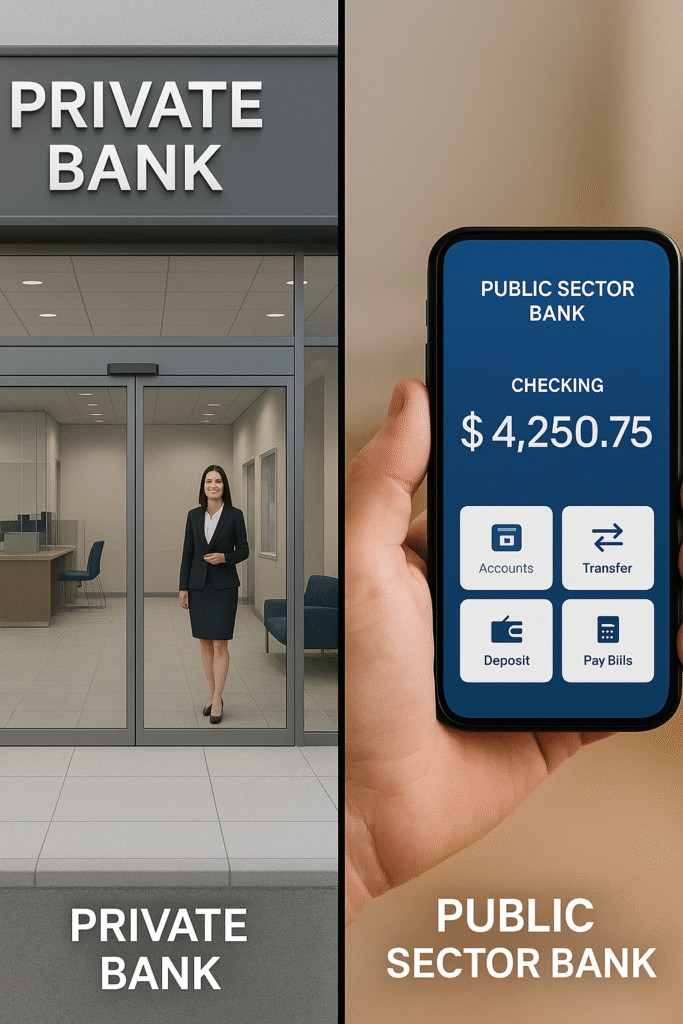
This table shows a clear divide — private banks demand far higher balances than public sector banks.
Adani vs Ambani in 2025: The Billionaire Battle for India’s Future
Why Public Sector Banks Could Benefit From This Change
The sudden hike in AMB by major private banks like HDFC and ICICI creates a window of opportunity for PSU banks:
- Lower Balance Requirements — Many PSU banks still allow accounts with ₹1,000–₹3,000 AMB or even zero-balance accounts.
- Trust Factor — Government backing makes public banks attractive to rural and semi-urban customers.
- Financial Inclusion — With a focus on Jan Dhan Yojana and similar schemes, PSU banks can capture the customers private banks are pushing away.
Expert-Style Analysis — What This Means for Banking in India
- Shift Toward High-Net-Worth Clients
Private banks are targeting customers who can bring higher deposits, which means fewer low-balance accounts. - Pressure on Middle-Income Customers
While wealthy customers won’t notice, middle-class account holders may feel squeezed between the desire for premium service and the reality of high AMB. - Rise of Fintech Banking
Digital banks with zero-balance requirements will attract younger, tech-savvy customers. - Potential Regulatory Pushback
If these hikes create exclusion, regulators could step in to ensure basic banking remains accessible.

How to Avoid Fees After the HDFC Bank Minimum Balance Hike 2025
- Opt for a Salary Account – If your employer banks with HDFC, ask for a zero-balance salary account.
- Maintain Balance via FD Link – Link a fixed deposit to your savings account to meet AMB without freezing your liquid funds entirely.
- Use Sweep-in Facility – Keep extra money in an FD and auto-sweep it into your account when required.
- Consolidate Your Accounts – Fewer accounts make it easier to maintain the required balance.
- Go Digital – Consider HDFC’s digital savings products that have lower or no AMB rules.
Customer Story — The Middle-Class Squeeze
Priya Sharma, a 32-year-old marketing executive in Delhi, opened a new HDFC account in August 2025, unaware of the new rules. By the second month, her balance dropped to ₹18,000 due to rent and utility payments.
When she checked her statement, she found ₹1,000 deducted as AMB penalty.
“I was shocked,” she says. “The bank didn’t make it clear when I signed up. If I’d known, I might have chosen a different account or a different bank altogether.”
Priya’s case is a warning — always ask about AMB rules before opening any new account.
Alternatives for Low-Balance Customers
If you don’t want to get caught in high-balance traps:
- Basic Savings Bank Deposit Account (BSBDA) – Zero balance, limited transactions, but no penalties.
- Jan Dhan Yojana Account – Fully government-backed, no minimum balance.
- Public Sector Savings Accounts – SBI, Canara, and Bank of Baroda offer low AMB.
- Digital-Only Banks – Some fintechs like Fi, Jupiter, and Paytm Payments Bank allow zero balance.
The Future — Will All Banks Raise Their AMB?
With ICICI and HDFC moving first, other private banks could soon follow. If Axis or Kotak hike their limits, the private banking space will become premium-only by default.
This could push millions toward PSU banks, reshaping India’s retail banking landscape in just a few years.
Final Takeaway — How to Stay Ahead of the Change
- If you already have an HDFC account, you’re safe under old rules — but be aware of possible future hikes.
- If you’re opening a new account, shop around before choosing.
- Always keep a cushion above your AMB to avoid penalties.
- Don’t hesitate to close accounts that are costing you more in penalties than they earn in interest.
Conclusion — The New Reality of Private Banking in India
The ₹25,000 minimum balance rule at HDFC Bank is more than just a policy change — it’s a sign of where private banking is headed. For some, it’s a minor inconvenience. For others, it’s a wall blocking access to premium banking services.
In the coming years, we may see two very different banking worlds:
- One for affluent customers with high balances and premium services.
- Another for low-income and cost-conscious customers, served by public sector banks and fintech startups.
For now, the smartest move you can make is staying informed, comparing options, and avoiding unnecessary charges. In banking, knowledge really is money.